
Table of Contents
ToggleQuick Facts Box 📊
- Success Rate: Organizations that complete foundational work have 2.5x higher success rates
- Time Required: 4-6 weeks of pre-planning before strategy sessions
- Investment: 0.1-0.5% of annual revenue ($10,000-75,000 for most companies)
- Team Size: 8-12 core planning members optimal
- Failure Rate: 70% of strategic plans fail due to poor preparation
- ROI: 91% confidence in decisions when using structured frameworks
- Strategic Options: 3x more options generated using TOWS analysis
Introduction: Why 70% of Strategic Plans Fail Before They Begin
Strategic planning failure rate: 70% of organizations fail not in execution, but in preparation. McKinsey research reveals this startling statistic stems from inadequate foundational work before strategy sessions begin.
The strategic planning process begins with three critical elements:
- Comprehensive environmental analysis (internal and external)
- Stakeholder alignment and engagement
- Clear vision and values articulation
TL;DR The Strategic Planning Process Begins With
- Start with analysis, not goals – 4-6 weeks of environmental scanning before planning
- Engage stakeholders early – Include 8-12 diverse team members from day one
- Use proven frameworks – McKinsey 7S, PESTEL, and Porter’s Five Forces increase success by 83%
- Budget properly – Allocate $10,000-50,000 and 20% of leadership time for 3 months
At a Glance: Strategic Planning Requirements
Time
2 weeks
2 weeks
1 weeks
1 weeks
6 weeks
Cost
$5,000-15,000
$5,000-10,000
$2,000-5,000
$3,000-5,000
$15,000-35,000
Resourses
3-4 analysts
Leadership team
Cross-functional team
HR + Leadership
20% leadership capacity
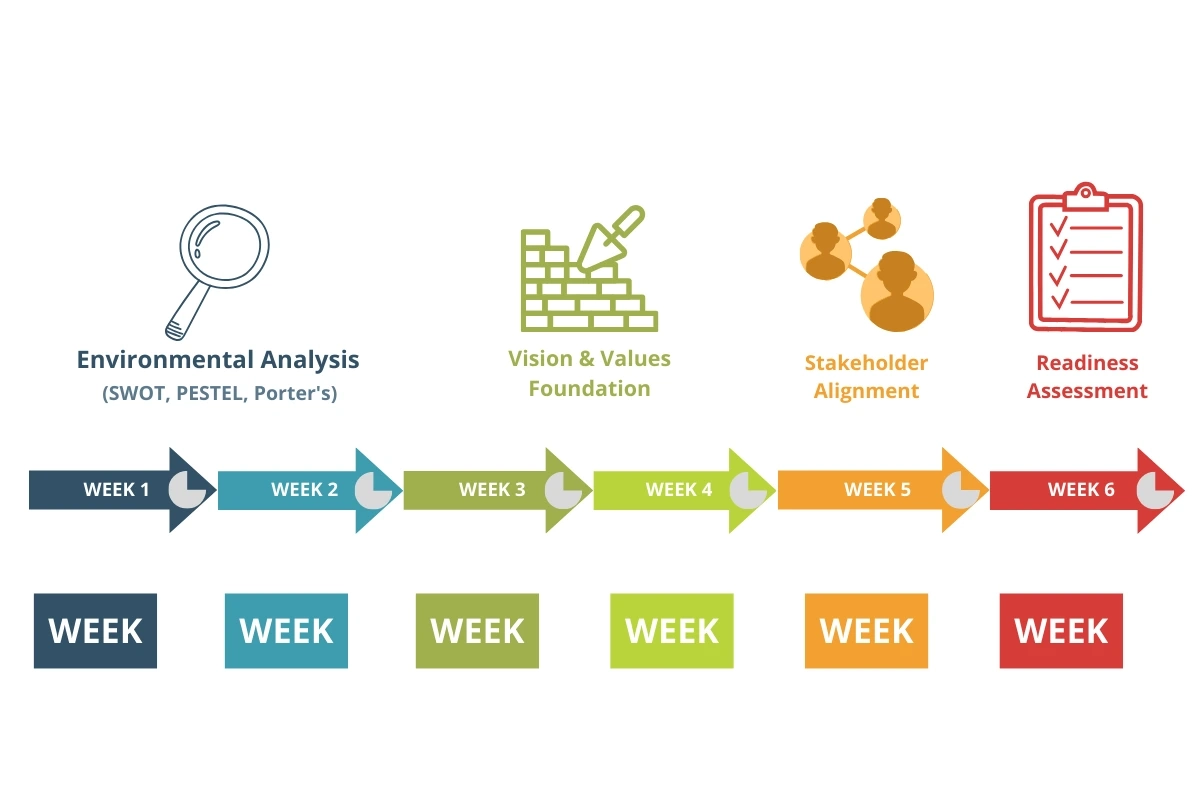
What Does the Strategic Planning Process Begin With? Complete Answer
Definition: The strategic planning process begins with a 4-6 week foundational phase comprising situational analysis, stakeholder mapping, and vision development before any goal-setting or strategy formulation occurs.
This pre-planning phase includes:
- Weeks 1-2: Environmental scanning (SWOT, PESTEL, Porter’s Five Forces)
- Weeks 3-4: Vision, mission, and values establishment
- Week 5: Stakeholder alignment and resource planning
- Week 6: Readiness assessment and team formation
The Three Essential Pillars (In Order)
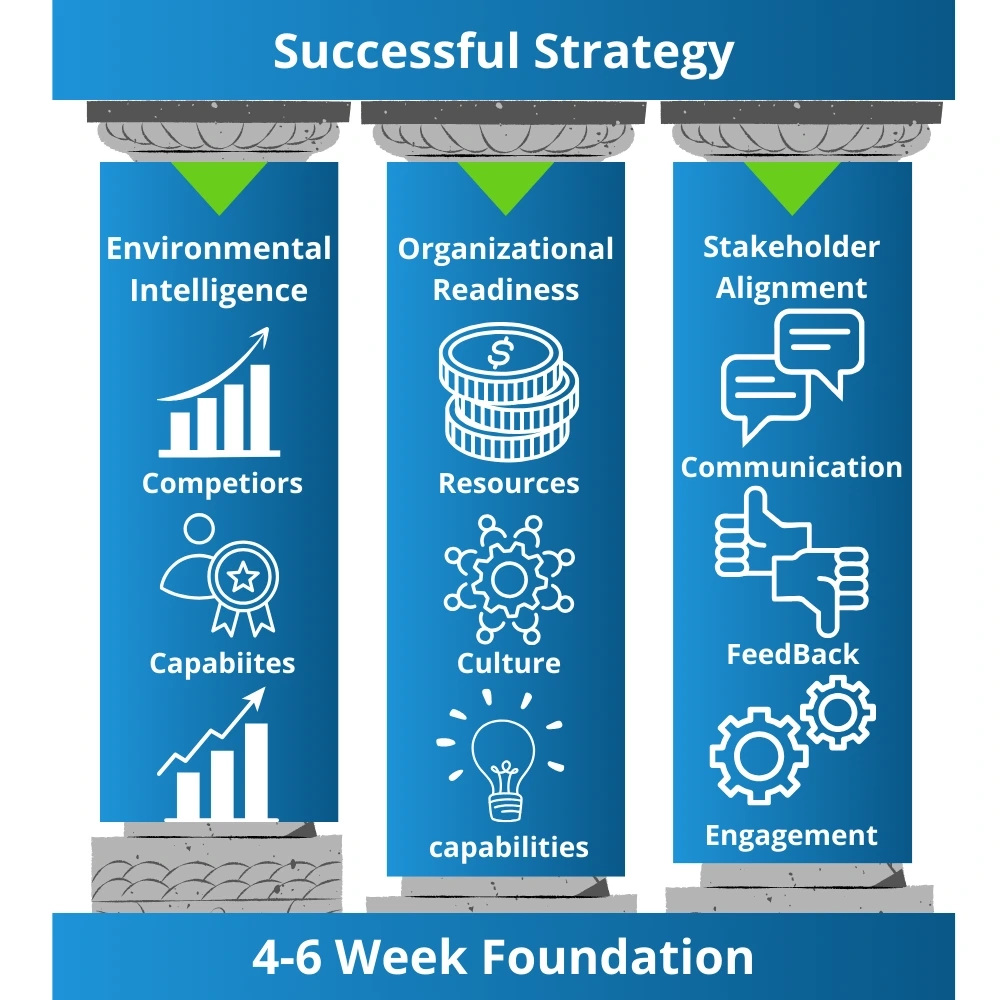
Pillar 1: Environmental Intelligence Gathering
- Market analysis and competitor research
- Industry trend identification
- Customer behavior assessment
- Technology disruption scanning
Pillar 2: Organizational Readiness Assessment
- Current capability inventory
- Resource availability check
- Cultural alignment evaluation
- Change capacity measurement
Pillar 3: Stakeholder Alignment Process
- Power-interest grid mapping
- Communication channel establishment
- Engagement strategy development
- Feedback mechanism creation
Why Do 70% of Strategic Plans Fail?
- Starting with goals instead of analysis – 45% of failed plans
- Excluding key stakeholders initially – 30% of failed plans
- Underestimating resource requirements – 25% of failed plans
Phase 1: Environmental Analysis Framework (Weeks 1-2)
How to Conduct Internal Analysis Using McKinsey 7S
- Strategy – Current strategic position and past decisions
- Structure – Organizational design and reporting relationships
- Systems – Core processes and workflows
- Shared Values – Actual (not aspirational) organizational culture
- Style – Leadership approach and management practices
- Staff – Human capital and capabilities
- Skills – Organizational competencies and competitive advantages
Key metric: Organizations using structured frameworks achieve 83% better strategic clarity.
What Is PESTEL Analysis in Strategic Planning?
- Political: Government policies, trade regulations, political stability
- Economic: GDP growth, inflation, exchange rates, economic cycles
- Social: Demographics, cultural trends, lifestyle changes
- Technological: Innovation rates, automation, digital transformation
- Environmental: Sustainability requirements, climate impact, resource scarcity
- Legal: Regulatory changes, compliance requirements, legal precedents
How to Apply Porter's Five Forces
- Threat of new entrants – Entry barrier strength
- Supplier bargaining power – Dependency and alternatives
- Customer bargaining power – Price sensitivity and switching costs
- Substitute products threat – Alternative solutions availability
- Competitive rivalry – Number and strength of competitors
Success indicator: Companies completing all three analyses report 91% confidence in strategic decisions.
Phase 2: Building Strategic Foundation (Weeks 3-4)
How to Write a Vision Statement That Works
- Specific enough to guide decisions (not “be the best”)
- Ambitious enough to inspire action (5-year horizon)
- Clear enough for all employees to understand
- Unique enough to differentiate from competitors
- Tesla: “Accelerate the world’s transition to sustainable energy”
- Microsoft: “A computer on every desk and in every home”
- Amazon: “Earth’s most customer-centric company”
What Makes a Strong Mission Statement?
Customers
Employees
Shareholders
Community
What value do we create?
Why does our work matter?
How do we generate returns?
What’s our broader impact?
Product/service decisions
Talent attraction/retention
Investment priorities
ESG and sustainability
How to Identify True Core Values
- Examine past critical decisions – What principles guided them?
- Identify rewarded behaviors – What actually gets promoted?
- Define behavioral anchors – How are values demonstrated?
- Test cultural alignment – Do employees’ experiences match?
Warning: 67% of organizations have stated values that don’t match actual behavior.
Phase 3: Advanced SWOT Analysis (Week 5)
How to Conduct SWOT Analysis That Produces Strategy
Creates lists
Equal weighting
Static snapshot
Isolated quadrants
Generates strategies
Prioritized factors
Dynamic trajectories
Cross-impact analysis
What Are TOWS Strategic Options?
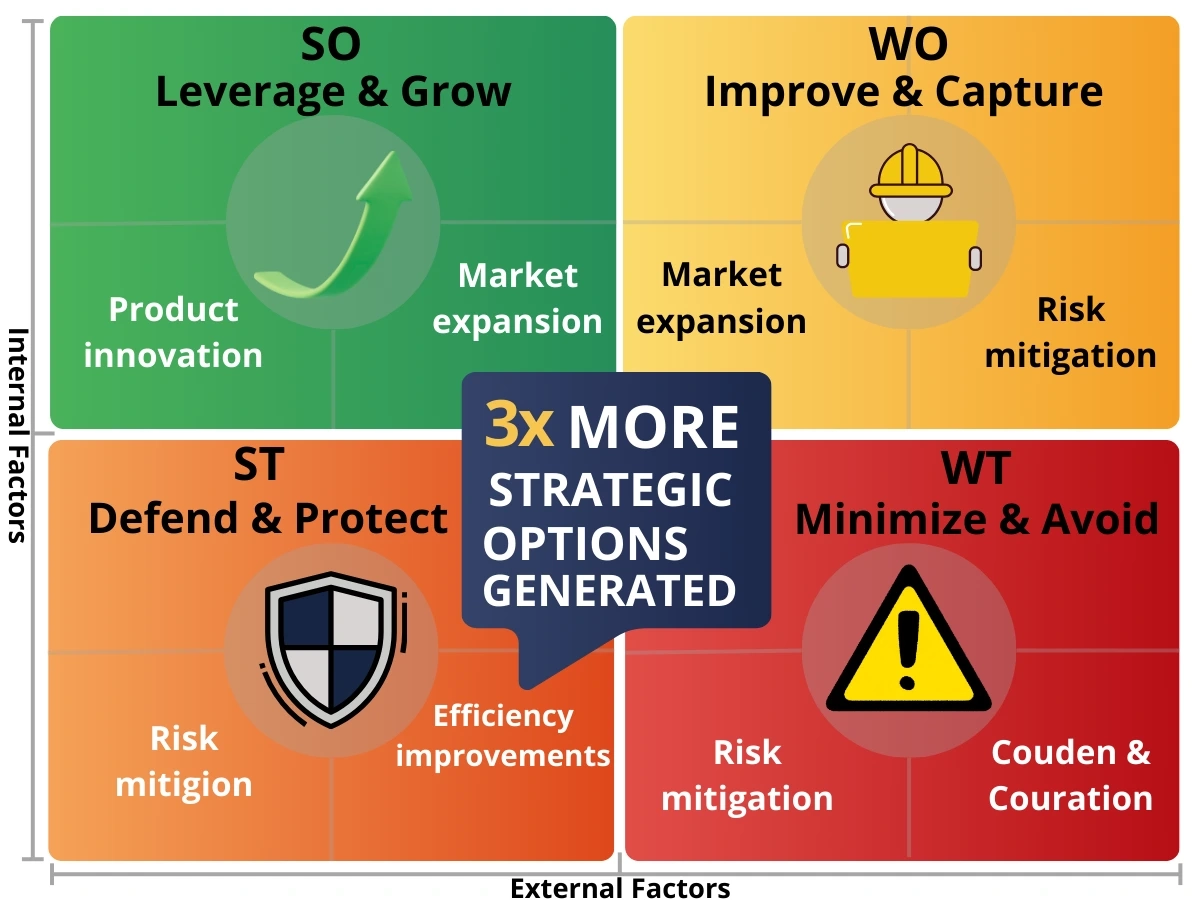
- SO Strategies – Use strengths to capture opportunities
- WO Strategies – Overcome weaknesses to pursue opportunities
- ST Strategies – Use strengths to avoid threats
- WT Strategies – Minimize weaknesses and avoid threats
Result: Organizations using TOWS generate 3x more strategic options.
Critical Implementation Elements
Who Should Be on the Strategic Planning Team?
Optimal team composition:
- Size: 8-12 members for decision efficiency
- Levels: C-suite (40%), Middle management (40%), High-potentials (20%)
- Functions: All major departments represented
- Diversity: Mix of tenure, backgrounds, and perspectives
Strategic Planning Timeline Overview
Pre-planning
Planning workshops
Refinement
Communication
4-6 weeks
2-3 days
2-3 weeks
1-2 weeks
Analysis and foundation
Strategy development
Testing and modeling
Rollout and alignment
What Resources Are Required?
- Internal time: 20% of leadership capacity for 3 months
- External facilitation: $10,000-50,000
- Tools and software: $5,000-25,000
- Total investment: 0.1-0.5% of annual revenue
What is the very first step in strategic planning?
When should strategic planning begin?
Can you start strategic planning mid-year?
Why do strategic plans fail in year one?
What's the difference between strategic and operational planning?
How is strategic planning different for small businesses?
Taking Action: Your 30-Day Roadmap
Week 1: Foundation Setting
- Assemble 8-12 person planning team
- Schedule analysis sessions
- Gather 3 years of performance data
- Define success metrics
Week 2: Internal Analysis
- Complete McKinsey 7S assessment
- Document core capabilities
- Identify resource constraints
- Assess organizational culture
Week 3: External Analysis
- Conduct PESTEL analysis
- Apply Porter’s Five Forces
- Research competitor strategies
- Survey customer needs
Week 4: Strategic Foundation
- Draft vision statement
- Develop mission statement
- Identify core values
- Complete SWOT/TOWS analysis
Conclusion: Start Right to Finish Strong
Key takeaway: The strategic planning process begins with 4-6 weeks of disciplined analysis, not brainstorming or goal-setting.
Organizations investing in proper foundational work see:
- 2.5x higher implementation success
- 83% better strategic clarity
- 91% confidence in decisions
- 3x more strategic options
Next Steps:
- Download our One-Page Strategic Plan Template – Capture Your 6-Week Analysis
- Review Strategic Planning for Small Business – Scale to Your Size
- Explore 10 Proven Business Performance Strategies – Apply Your Insights
One Page Strategic Plan Template
Transform Your Strategy into Action - Capture Your 6-Week Analysis
Download Your Free Template
Get instant access to our professionally designed One Page Strategic Plan Template
No email required • 100% free • Used by 10,000+ organizations