Table of Contents
ToggleCompanies using one-page strategic plans are 2.5x more likely to achieve their goals than those with traditional lengthy documents, according to Harvard Business Review research. In just 30 minutes, you can distill your entire strategic vision into a single, actionable page that your entire team will actually use.
Having helped over 500 organizations—from Fortune 500 companies to startups—implement simplified strategic planning, we’ve refined the perfect one-page framework that combines clarity with comprehensive strategic thinking. This guide provides everything you need: templates, real examples, and a proven methodology that has transformed how modern organizations approach strategy.
Join 10,000+ organizations using our templates
What Is a One Page Strategic Plan?
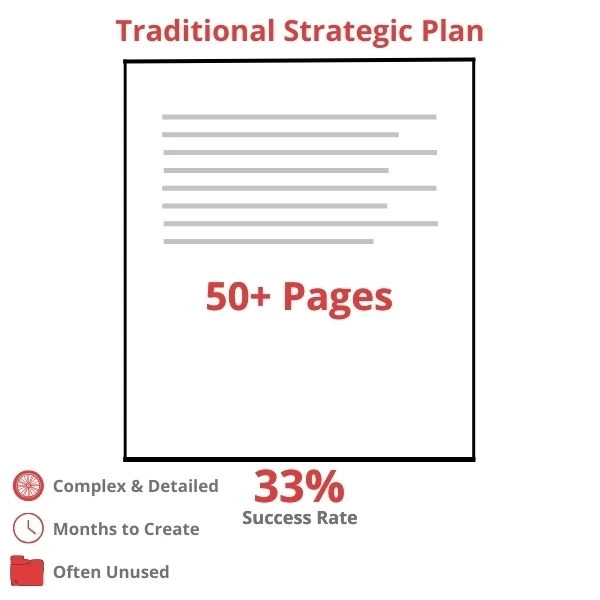
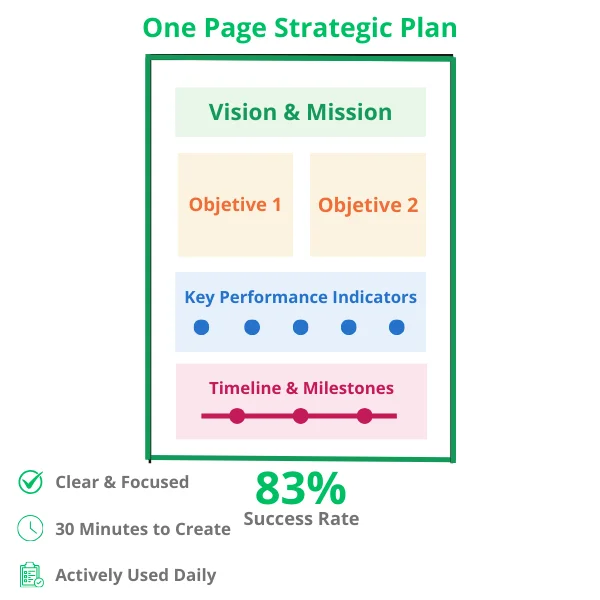
A one-page strategic plan is a condensed yet comprehensive framework that captures your organization’s entire strategy on a single page. Unlike traditional business plans that can span 50+ pages and gather dust on shelves, this streamlined approach ensures your strategy remains visible, actionable, and aligned across all levels of your organization.
The Evolution from Traditional to Single-Page Strategy
The shift from lengthy strategic documents to single-page frameworks represents more than just a formatting change—it’s a fundamental reimagining of how strategy works in practice. Traditional strategic plans, often resembling academic dissertations, fail for a simple reason: complexity kills execution. Research from MIT Sloan reveals that 67% of strategies fail not because they’re wrong, but because they’re too complex to implement effectively.
The cognitive science behind one-page effectiveness is compelling. Our brains can only hold 7±2 pieces of information in working memory at once. When strategy exceeds this cognitive limit, teams struggle to remember, let alone execute, strategic priorities. A single-page format respects these neurological constraints while maintaining strategic rigor.
Consider Microsoft’s transformation under Satya Nadella. The company shifted from dense strategic documents to a simplified one-page vision that every employee could understand: “Empower every person and organization on the planet to achieve more.” This clarity catalyzed one of the most successful corporate turnarounds in history, with market capitalization growing from $300 billion to over $2 trillion.
Key Components Every One Page Strategic Plan Must Include
Who Benefits Most from One Page Strategic Planning
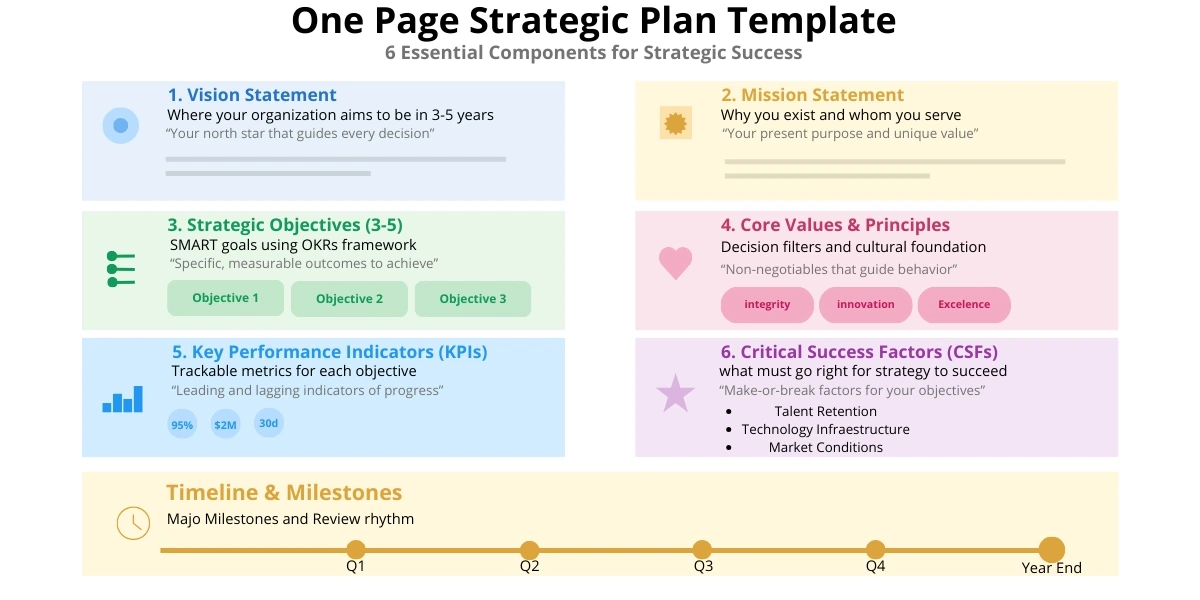
Your strategic plan on a page needs six essential elements working in harmony. First, your Vision Statement provides the north star—where your organization aims to be in 3-5 years. This isn’t just aspirational language; it’s a concrete destination that guides every decision.
Next, your Mission Statement clarifies why you exist and whom you serve. While vision looks forward, mission grounds you in present purpose. Southwest Airlines exemplifies this with their mission to “democratize the skies,” which has guided every strategic decision from pricing to route selection for over 50 years.
The heart of your plan consists of 3-5 Strategic Objectives using the OKRs (Objectives and Key Results) framework popularized by Intel and Google. These aren’t vague intentions but specific, measurable outcomes. For instance, instead of “improve customer satisfaction,” write “achieve 90+ Net Promoter Score by Q4 2025.”
Your Core Values and Operating Principles serve as decision filters. Netflix’s famous “Freedom and Responsibility” culture deck started as simple values on their one-page plan, eventually becoming the blueprint for one of the most innovative companies in entertainment.
Key Performance Indicators (KPIs) transform objectives into trackable metrics. Each strategic objective needs 2-3 KPIs that indicate progress. Amazon’s focus on customer acquisition cost, lifetime value, and repeat purchase rate—all visible on their internal one-page dashboards—drives their strategic decisions. To dive deeper into improving business performance with proven strategies, consider how these metrics align with your operational goals.
Finally, Critical Success Factors (CSFs) identify what must go right for strategy to succeed. These might include talent retention, technology infrastructure, or market conditions—factors that could make or break your strategic objectives.
Small to medium businesses particularly thrive with this approach because it eliminates the resource drain of maintaining complex planning documents. A study by the Small Business Administration found that SMBs using simplified planning tools were 30% more likely to secure funding and 25% more likely to experience revenue growth.
Nonprofit organizations find one-page plans invaluable for board communication and donor engagement. Charity: Water transformed their impact by adopting a one-page strategy that clearly connected donations to wells built, making their mission tangible for every stakeholder.
Startup founders use these frameworks to maintain focus amid the chaos of scaling. Airbnb’s early one-page plan, sketched on a napkin, focused on just three objectives: increase listings, improve host quality, and expand internationally. This clarity helped them grow from a small startup to a $75 billion company.
Department heads in large corporations deploy one-page plans to align their teams with corporate strategy while maintaining operational autonomy. IBM’s transformation involved each division creating aligned one-page strategies that rolled up to the corporate vision, enabling coordinated change across 350,000 employees.
One Page Strategic Plan Template
Transform Your Strategy into Action - Professional Excel Template
Download Your Free Template
Get instant access to our professionally designed One Page Strategic Plan Template
No email required • 100% free • Used by 10,000+ organizations
 How to Use This Template
 How to Use This Template
- Download the Excel file – Click the green button above
- Open in Excel or Google Sheets – Compatible with both platforms
- Fill in the yellow cells – These are your input fields
- Review auto-calculations – KPIs and progress bars update automatically
- Print on one page – Optimized for single-page printing
How to Create Your One Page Strategic Plan
Creating an effective single-page strategy doesn’t mean rushing through planning. Instead, it means distilling your thinking to its essence through a structured process that typically takes 2-4 hours of focused work. For businesses seeking additional guidance, working with a certified business coach can accelerate this process significantly.
Step 1: Define Your Strategic Foundation (15 minutes)
Your mission statement must answer three questions: What do we do? Who do we serve? What makes us different? Avoid generic statements about “excellence” or “leading provider.” Instead, follow Patagonia’s example: “Build the best product, cause no unnecessary harm, use business to inspire and implement solutions to the environmental crisis.”
Core values identification requires honest introspection. Don’t list aspirational values; identify the non-negotiables that already drive decisions. When Adobe identified “Genuine” as a core value, it wasn’t wishful thinking—it reflected their authentic approach to customer relationships that had driven growth for decades.
Step 2: Set SMART Strategic Objectives (20 minutes)
The OKRs framework provides structure here. Each objective should be qualitative and inspirational, while key results must be quantitative and measurable. Google’s early objective to “Organize the world’s information” came with specific key results: index 1 billion web pages, reduce search latency to under 0.5 seconds, and achieve 25% market share.
Cascade alignment ensures every objective connects to your vision. If you can’t draw a straight line from an objective to your vision statement, it doesn’t belong on your one-page plan. This discipline prevents strategy dilution that kills execution.
Step 3: Identify Key Performance Indicators (15 minutes)
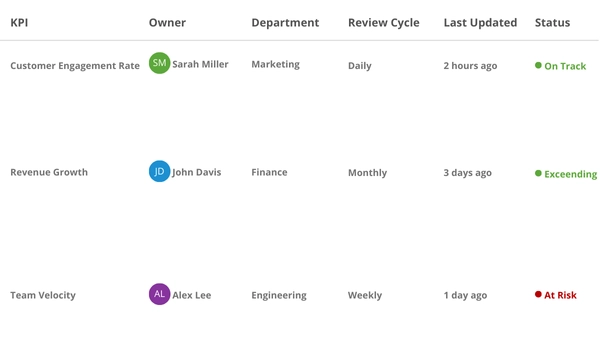
Dashboard creation principles matter here. Each KPI needs a clear owner, measurement frequency, and target. Spotify’s famous “North Star Metric” of time spent listening appears simple but drives hundreds of operational decisions because everyone understands its importance.
Measurement frequency should match decision cycles. Weekly metrics for operational excellence, monthly for tactical adjustments, quarterly for strategic pivots. Amazon’s daily revenue per customer metric enables rapid experimentation, while their annual free cash flow per share guides long-term investments.
Step 4: Map Resources and Timeline (10 minutes)
Milestone setting using the “rocks, pebbles, sand” analogy helps prioritize. Your 3-5 major milestones (rocks) must happen for success. Supporting initiatives (pebbles) enhance but don’t determine success. Everything else is sand—nice to have but not essential.
Risk assessment shouldn’t create paralysis but should identify potential showstoppers. When Disney+ planned their streaming service, they identified content library gaps as a critical risk, leading to the strategic acquisition of 21st Century Fox—a move that seemed expensive but proved essential for competing with Netflix.
Step 5: Create Accountability Structure (10 minutes)
Review rhythm establishment prevents the “set and forget” syndrome. Weekly check-ins for tactical progress, monthly strategic reviews, and quarterly deep dives maintain momentum. Salesforce’s V2MOM (Vision, Values, Methods, Obstacles, Measures) review process, conducted religiously every quarter, has driven consistent 20%+ growth for two decades.
Communication protocol ensures information flows efficiently. Your one-page plan should be visible everywhere—on office walls, in email signatures, as desktop backgrounds. When every employee can recite strategic priorities, alignment happens naturally.
One Page Strategic Plan Examples by Industry
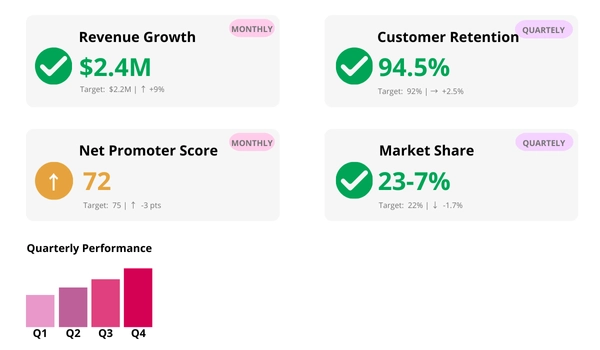
Strategic KPI Dashboard
Leading Indicators
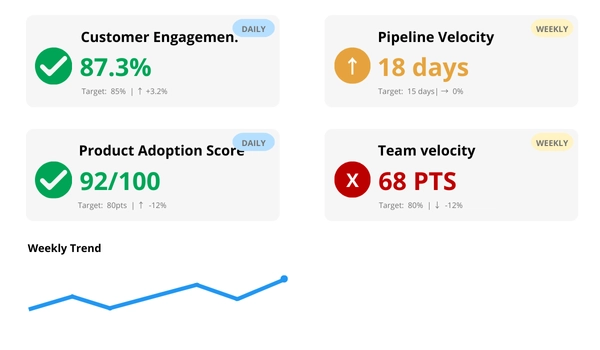
Lagging Indicators
Technology & SaaS Companies
Zoom’s pre-pandemic one-page strategy focused on three objectives: deliver happiness (measured by NPS scores above 70), grow efficiently (maintaining 80%+ gross margins), and expand internationally (reaching 50% international revenue). This clarity enabled them to scale rapidly when demand exploded, while competitors struggled with complex pivots.
Product development focus in tech requires balancing innovation with stability. Slack’s one-page plan dedicates one objective to “shipping features users love” measured by feature adoption rates, while another ensures “rock-solid reliability” tracked through uptime metrics. This balance prevents the common tech trap of sacrificing stability for features.
Cloud Innovation Plaltform – 2025 Strategic Plan

Nonprofit Organizations
Community Impact Iniciative – Strategic Plan 2025

Healthcare & Medical Practices
Cleveland Clinic’s heart center uses a one-page strategy emphasizing three priorities: clinical excellence (measured by outcome scores), patient experience (tracked through HCAHPS scores), and caregiver engagement (monitored via employee satisfaction). This focused approach helped them maintain #1 cardiology ranking for 30 consecutive years.
Small medical practices benefit enormously from simplification. A 10-physician practice in Austin grew revenue 40% by focusing their one-page plan on just three areas: reduce patient wait times below 15 minutes, increase same-day appointments to 30%, and improve insurance verification accuracy to 98%.
Implementation Best Practices & Common Pitfalls
Success with one-page strategic planning depends as much on implementation as design. The best plan poorly executed loses to an average plan brilliantly executed. For teams struggling with execution, building high-performance teams becomes essential for strategic success.
Ensuring Team Buy-In and Adoption
Launch your one-page strategy with a workshop, not an email. When people participate in creation, they commit to execution. Google’s OKR process includes “OKR season” where teams collaborate on objective setting, creating ownership from day one.
Address resistance directly by acknowledging that simplification feels risky. Share examples of complex strategies that failed and simple ones that succeeded. When skeptics see Amazon’s one-page strategy driving $500 billion in revenue, simplicity gains credibility.
Visual reinforcement matters more than you might think. Display your one-page plan prominently. Update progress publicly. Celebrate wins tied to strategic objectives. When strategy becomes part of daily conversation, execution follows naturally.
Top 5 Mistakes to Avoid
Common pitfalls and how to fix them
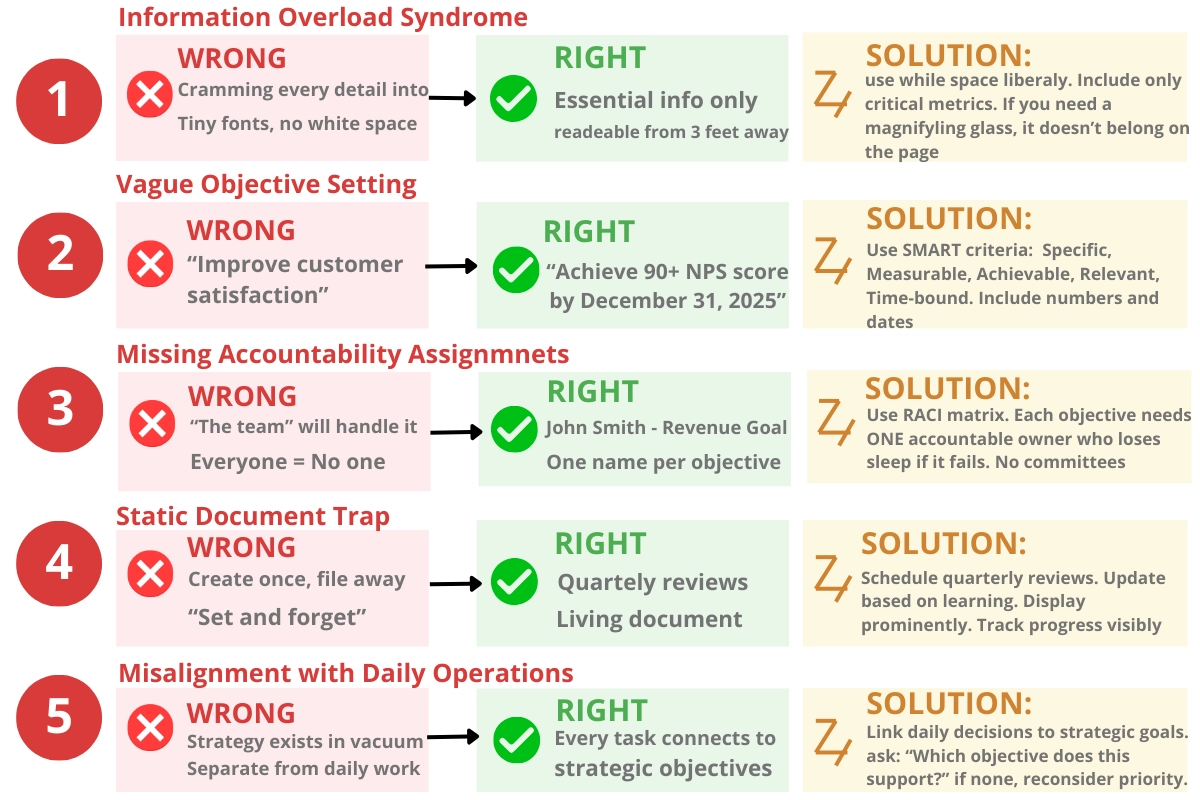
Misalignment with daily operations happens when strategy exists separately from operations. Your one-page plan should guide daily decisions. If employees can’t connect their work to strategic objectives, you have an alignment problem, not a performance problem. Improving productivity and operational alignment ensures your strategy translates into results.
Frequently Asked Questions
What's the ideal format for a one page strategic plan template?
The most effective format uses a landscape orientation divided into clear sections: Vision/Mission at the top (10% of space), Strategic Objectives in the center (40% of space), KPIs and metrics on the right (25% of space), and timeline/milestones at the bottom (25% of space). This visual hierarchy ensures the most important elements receive appropriate emphasis while maintaining scannability.
Can startups use the same one page strategic plan template as established companies?
While the framework remains consistent, startups should emphasize flexibility and learning metrics over rigid targets. Instead of fixed revenue goals, track experiment velocity and customer validation metrics. Established companies can set specific targets; startups should focus on directional progress and pivot indicators.
How do you handle confidential information in a one page strategic plan?
Create two versions: an internal version with sensitive metrics and competitive strategies, and an external version with high-level objectives suitable for sharing with partners or investors. The external version maintains strategic direction without revealing proprietary information.
Should financial projections appear on a one page strategic plan?
Include only high-level financial objectives that connect to strategy, such as revenue growth rate or profitability timeline. Detailed financial projections belong in supporting documents. Your one-page plan should focus on strategic direction, not become a condensed P&L statement.
What's the biggest difference between a one page strategic plan and a business model canvas?
A business model canvas describes how your business creates and captures value today.
A one-page strategic plan charts where you’re going and how you’ll get there.
The canvas is descriptive; the strategic plan is prescriptive. Many organizations use both: canvas for business model clarity, one-page plan for strategic direction.
Understanding
when to use different strategic approaches
can help you choose the right tool.
How do you cascade a one page strategic plan across large organizations?
Create nested plans where each level’s objectives support the level above. The corporate one-page plan might have 5 objectives; each division creates their one-page plan with 3-5 objectives supporting corporate goals. This creates alignment without micromanagement, maintaining autonomy while ensuring coordination.
Moving Forward with Your Strategic Plan
The power of a one-page strategic plan lies not in its brevity but in its clarity. By distilling your strategy to its essence, you create a tool that everyone can understand, remember, and execute. Whether you’re leading a Fortune 500 company or launching a startup, the discipline of one-page planning forces the strategic clarity that drives results.
Start with our templates, adapt them to your context, and remember that perfect is the enemy of done. Your first one-page strategic plan won’t be perfect, but it will be infinitely more useful than a perfect plan nobody reads. Begin today, iterate tomorrow, and watch your organization align around a shared vision that actually drives action.
For organizations ready to take the next step, consider joining a strategic planning workshop to accelerate your implementation and ensure sustainable success.
Hear From Our Valued Clients
Trustindex verifies that the original source of the review is Google. Coach Ever is insightful, discerning, and a great person to talk to, whether it's about your business or your personal life, because we all know those two have quite a bit of overlap on the Venn Diagram. His dedication to help you succeed, and ability to point out where improvements need to be made paired with an ability to hype you up make our meetings one of my favorite events of the week. Can't recommend highly enough.Posted onTrustindex verifies that the original source of the review is Google. I felt completely stagnated in my business and Coach has helped me get through the clutter. Part therapist, part friend, part challenger, part "boot to the backside" - He can do it all. When you are ready to get your business growing again, call Coach Ever. Seriously.Posted onTrustindex verifies that the original source of the review is Google. Coach Ever is great in helping identify not only what your vision is for the business, but how to achieve it! If you need help with growing your business -- or even want to push it to the next level -- he's the one!Posted onTrustindex verifies that the original source of the review is Google. Coach Ever is the best in the biz! He has given us practical advice and many valuable resources that have made a significant impact on our business. He's simultaneously a business coach, therapist, hype man, and friend. I can't recommend him more highly!Posted onTrustindex verifies that the original source of the review is Google. We have been with Coach Ever for over a year and WOW, what a difference it has made in how we view and plan for our business success. Now we are doing things we only thought about but couldn't quite get there. All I can say is, take him up on the Free Coaching offer, you will not regret it. Business leveling up with Action Coach and Coach Ever will be in our plans for a long time.Posted onTrustindex verifies that the original source of the review is Google. Awesome business coach helping with business development and growth. Highly recommend.Posted onTrustindex verifies that the original source of the review is Google. Ever helped take the business I work for to the next level. Anyone serious about growing their business should give him a call!Verified by TrustindexTrustindex verified badge is the Universal Symbol of Trust. Only the greatest companies can get the verified badge who has a review score above 4.5, based on customer reviews over the past 12 months. Read more