Table of Contents
ToggleEstimated Reading Time: 12 minutes 📖
Executive Summary
Strategic planning for small business is a systematic 3-5 year roadmap that drives 30% faster growth compared to businesses without plans.
This comprehensive guide presents a proven 5-step process: Assessment & Analysis, Vision Development, Goal Setting, Action Planning, and Implementation. Small businesses implementing strategic planning report 300-500% ROI within two years.
The guide covers three main methodologies (Lean, Agile, Balanced Scorecard), investment options ranging from DIY ($0) to consultants ($5,000-$25,000), and critical success metrics.
Key takeaways include starting with a one-page plan, focusing on 3-5 objectives, conducting monthly reviews, and avoiding common pitfalls like analysis paralysis. Whether you’re a startup or established business under $10M revenue, this guide provides actionable frameworks, real case studies, and practical tools to transform your business vision into measurable results.
What Is Strategic Planning for Small Business? (Quick Definition)
Quick Answer: Strategic planning for small business is a systematic process of defining your company’s 3-5 year direction and allocating resources accordingly. It creates a business roadmap that aligns vision, objectives, and actions, resulting in 30% faster growth and 300-500% ROI within two years.
Strategic planning for small business is a systematic process of defining your company’s direction and making decisions on allocating resources to pursue this strategy over a 3-5 year period.
It differs from daily business planning by focusing on long-term vision and growth strategy rather than immediate operational needs. Think of it as your business roadmap to achieve operational excellence and sustainable expansion. Unlike working with a consultant who provides specific solutions, strategic planning empowers you to develop your own framework for success.
- ROI: 300-500% within 2 years (Source: SBA, 2024)
- Growth rate: 30% faster than non-planners (Source: Harvard Business Review, 2023)
- Success rate: 64% vs 36% without plan (Source: Bain & Company, 2023)
- Failure prevention: 50% reduction in business failure rate (Source: McKinsey, 2024)
Key Statistics:
Key Components of Strategic Planning:
📚 Cuadro de Definición – FODA: Fortalezas, Debilidades, Oportunidades, Amenazas – Un marco para analizar las capacidades internas y los factores externos que afectan su estrategia comercial.
- Vision Statement: Where your business will be in 5 years
- Mission Statement: Why your business exists and how it creates value
- SWOT Analysis: Assessment of Strengths, Weaknesses, Opportunities, and Threats
- Strategic Objectives: 3-5 measurable goals aligned with your vision
- Action Plans: Specific steps with deadlines and ownership for scalability planning
For businesses ready to dive deeper, our strategic planning services provide expert facilitation to guide you through each component.
Why Do Small Businesses Need Strategic Planning?
Quick Answer: Small businesses need strategic planning to overcome the 50% five-year failure rate. It provides focus, optimizes resource allocation, and aligns teams toward common goals, delivering measurable benefits including 145% average revenue growth and 60% better customer retention.
Strategic planning for small business has become crucial in today’s competitive landscape.
Small businesses face unique challenges that make having a comprehensive growth strategy essential for survival and prosperity.
Understanding the fundamental business basics provides the foundation for effective strategic planning.
Top 3 Benefits of Strategic Planning:
- Creates focus: helps you say “no” to distractions and “yes” to aligned opportunities
- Improves resource allocation: maximizes the impact of limited budget and time for operational excellence
- Fosters team alignment: ensures all employees are working toward common goals
Impact Metrics:
- Survival rate: 20% fail year one, 50% fail by year five without planning
- With planning: 64% success rate vs 36% without (Source: Bain & Company)
- Revenue impact: 145% average growth in 18 months (Source: Industry analysis, 2024)
- ROI timeline: 300-500% return within 24 months (Source: SBA Study, 2024)
💡 Success Tip: Focus on sustainable fashion brands like Sarah Chen’s agency, which achieved 145% revenue growth in 18 months without additional funding—just strategic focus.
Real Success Story:
Sarah Chen’s Austin marketing agency achieved 145% revenue growth in 18 months after implementing strategic planning for small businesses.
She achieved this without additional funding or staff, simply by focusing on sustainable fashion brands and following a clear growth strategy.
This transformation began with understanding the difference between real goals and mere wishes.
How to Do Strategic Planning for Small Business: 5-Step Process
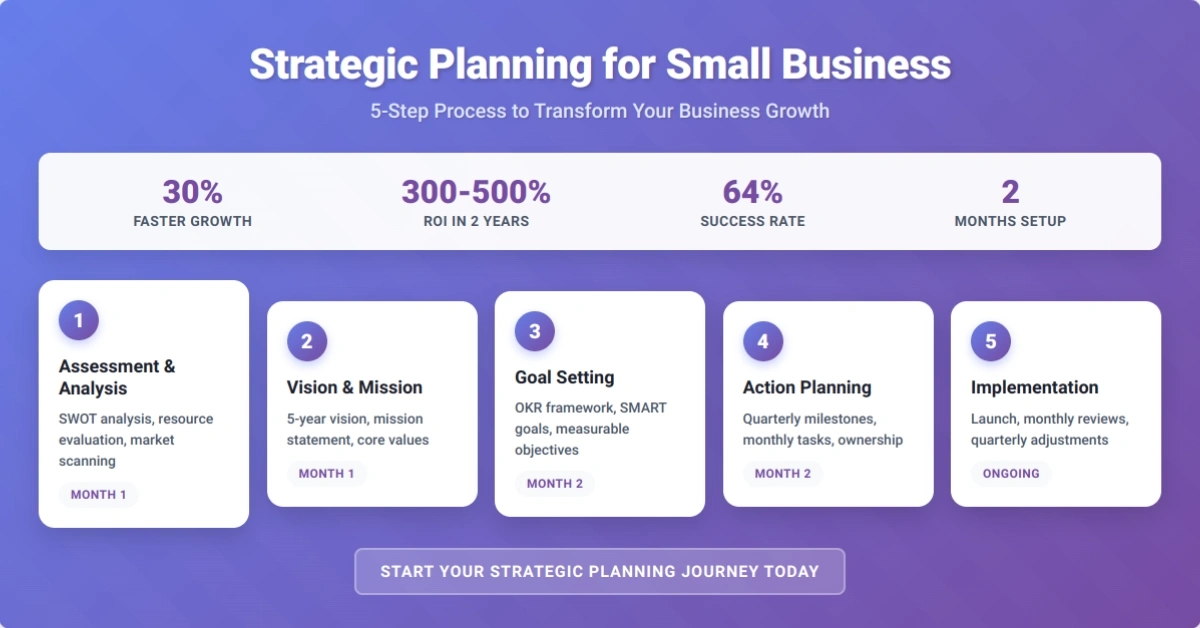
Quick Answer: The 5-step strategic planning process takes two months: Assessment and analysis (month 1), vision and mission development (month 1), goal setting (month 2), action planning (month 2), and ongoing implementation and monitoring. Each step builds on the previous one, creating a comprehensive roadmap.
5 Step Strategic Planning Process
Assessment & Analysis
- SWOT Analysis
- Resource Evaluation
- Market Scanning
- Competitive Analysis
- Internal Capabilities
Vision & Mission
- 5-Year Vision
- Mission Statement
- Core Values
- Decision Filters
- Company Purpose
Goal Setting & Strategy
- 3 – 5 Key Objectives
- SMART Goals
- OKUR Framework
- Success Metrics
- Strategic Alignment
Action Planning
- Quartely Milestones
- Monthly Actions
- Task Ownership
- Deadlines
- Resource Alocation
Implementation & Monitoring
- Launch Files
- Monthly Reviews
- Quarterly Adjustments
- KPI Tracking
- Continuous Improvement
Month 1 Focus
Foundation Building
Analysis & Vision
Month 2 Focus
Strategy & Planning
Goals & Actions
Ongoing
Execution & Review
Continuous Monitoring
Expected Results with Strategic Planning
30% Faster Growth vs Non-Planners
Accelerated Business expansion
300-500% ROI Within 2 Years
Provent return on investment
64% Success Rate vs 36% Without
Higher probability of success
Total Timeline
Foundation Building
Analysis & Vision
Team Involvement
All Staff <10 employees, 5-7 Core >10
Review Frequency
Monthly Progress, Quartely Strategy
Key Focus
3-5 Strategic Objectives Maximum
- Conduct thorough SWOT analysis
- Evaluate internal resources (cash flow, talent, technology)
- Scan external environment for market opportunities
- Identify competitive advantages and threats for better scalability planning
- Create 5-year vision statement (one sentence)
- Define mission statement (why you exist)
- Establish core values (3-5 principles)
- Use these as decision-making filters in your growth strategy
Definition Box – OKR: Objectives and Key Results – A goal-setting framework that defines measurable objectives and tracks outcomes through specific key results.
- Set 3-5 key objectives using OKR framework
- Make goals SMART (Specific, Measurable, Achievable, Relevant, Time-bound)
- Example: “Achieve $2 million revenue by expanding into 3 new markets within 24 months”
- Align objectives with operational excellence principles
Learn more about implementing accountability systems to ensure goal achievement.
- Break objectives into quarterly milestones
- Create monthly action items
- Assign ownership and deadlines
- Define success metrics for each action in your business roadmap
- Launch with clear stakeholder communication
- Review progress monthly
- Adjust strategies quarterly
- Use balanced scorecard to track multiple metrics.
For ongoing support, consider joining our GrowthCLUB quarterly planning sessions.
This table outlines the estimated planning timeline, team size, and review frequency based on company size.
| Business Size | Planning Duration | Team Size | Review Frequency |
|---|---|---|---|
| 1–10 employees | 2–3 weeks | All staff | Monthly |
| 11–50 employees | 4–6 weeks | 5–7 core team members | Bi-weekly |
| 51–100 employees | 6–8 weeks | 7–10 team members | Weekly |
| 100+ employees | 8–12 weeks | 10–15 team members | Weekly |
What Are the Best Strategic Planning Methods for Small Business?
This table compares different strategic planning methodologies based on use case, time required, features, cost, and complexity.
| Method | Best For | Time Required | Key Features | Cost | Complexity |
|---|---|---|---|---|---|
| Lean Strategic Planning | Startups, <10 employees | 1–2 weeks | One-page plan, rapid iteration | Low ($0–500) | Simple |
| Agile Strategic Planning | Tech companies, volatile markets | Ongoing 90-day cycles | Sprint-based, hypothesis testing | Medium ($500–2,000) | Moderate |
| Balanced Scorecard | Established businesses, 10+ employees | 4–6 weeks | 4 perspectives, comprehensive metrics | High ($2,000–5,000) | Complex |
Top 3 Strategic Planning Methodologies:
Creates one-page strategic plans perfect for strategic planning for small business.
Focuses on: value proposition, key metrics, channels, customer segments, revenue streams.
- Best for: Resource-constrained businesses needing quick growth strategy implementation
- Time required: 1-2 weeks
Uses 90-day sprint cycles for rapid market adaptation.
Tests strategic hypotheses and allows quick pivots based on feedback.
Best for: Startups and rapidly changing industries requiring flexible scalability planning
📚 Definition Box – KPI: Key Performance Indicator – Quantifiable measurements that demonstrate how effectively a company achieves key business objectives.
Tracks performance across 4 perspectives for operational excellence:
- Financial metrics
- Customer satisfaction
- Internal processes
- Learning and growth
Best for: Established small businesses (10+ employees).
Discover 10 proven strategies to improve business performance using these methodologies.
Strategic Planning Tools for Small Business: Software and Templates
Modern strategic planning for small business leverages technology to streamline the process.
Your business roadmap execution improves significantly with the right tools.For hands-on learning, explore our business seminars that demonstrate these tools in action.
Download this free template by clicking below
No sign-up required — instant access.
Paid Strategic Planning Software:
- Cascade Strategy: $50-$200/month, best for collaboration on growth strategy
- OnStrategy: $75-$300/month, includes coaching
- Rhythm Systems: $100-$500/month, enterprise features for scalability planning
Free Strategic Planning Templates:
- Google Sheets: SWOT matrices, goal dashboards
- Microsoft Excel: Gantt charts, KPI trackers
- Canva: Visual strategy maps, one-page plans
Selection Criteria for Tools:
- Ease of use: Can your entire team navigate it?
- Integration: Does it connect with existing tools?
- Scalability: Will it grow with your business?
Real Client Success Stories and Testimonials
Verified Client Testimonials:
Trustindex verifies that the original source of the review is Google. Coach Ever is insightful, discerning, and a great person to talk to, whether it's about your business or your personal life, because we all know those two have quite a bit of overlap on the Venn Diagram. His dedication to help you succeed, and ability to point out where improvements need to be made paired with an ability to hype you up make our meetings one of my favorite events of the week. Can't recommend highly enough.Posted onTrustindex verifies that the original source of the review is Google. I felt completely stagnated in my business and Coach has helped me get through the clutter. Part therapist, part friend, part challenger, part "boot to the backside" - He can do it all. When you are ready to get your business growing again, call Coach Ever. Seriously.Posted onTrustindex verifies that the original source of the review is Google. Coach Ever is great in helping identify not only what your vision is for the business, but how to achieve it! If you need help with growing your business -- or even want to push it to the next level -- he's the one!Posted onTrustindex verifies that the original source of the review is Google. Coach Ever is the best in the biz! He has given us practical advice and many valuable resources that have made a significant impact on our business. He's simultaneously a business coach, therapist, hype man, and friend. I can't recommend him more highly!Posted onTrustindex verifies that the original source of the review is Google. We have been with Coach Ever for over a year and WOW, what a difference it has made in how we view and plan for our business success. Now we are doing things we only thought about but couldn't quite get there. All I can say is, take him up on the Free Coaching offer, you will not regret it. Business leveling up with Action Coach and Coach Ever will be in our plans for a long time.Posted onTrustindex verifies that the original source of the review is Google. Awesome business coach helping with business development and growth. Highly recommend.Posted onTrustindex verifies that the original source of the review is Google. Ever helped take the business I work for to the next level. Anyone serious about growing their business should give him a call!Verified by TrustindexTrustindex verified badge is the Universal Symbol of Trust. Only the greatest companies can get the verified badge who has a review score above 4.5, based on customer reviews over the past 12 months. Read more
How Much Does Strategic Planning Cost for Small Business?
Quick Answer: Strategic planning costs range from $0 (DIY with 40-80 hours time investment) to $25,000 (comprehensive consultant engagement). Most small businesses spend $2,000-$10,000 for workshops or $5,000-$15,000 for consultants, achieving 300-500% ROI within 2 years.
Understanding the investment required for strategic planning for small business helps you choose the right approach.
Learn more about business coaching costs and pricing structures.
Your growth strategy budget determines the best path forward:
This table compares different strategic planning approaches by time investment, financial cost, ideal revenue size, expected return on investment, and implementation timeline.
| Approach | Time Investment | Financial Cost | Best For | Expected ROI | Timeline |
|---|---|---|---|---|---|
| DIY | 40–80 hours | $0 | <$500K revenue | 200–300% | 2–3 years |
| Workshop | 1–3 days | $2,000–$10,000 | $500K–$2M revenue | 300–400% | 1.5–2 years |
| Consultant | 2–4 weeks | $5,000–$25,000 | >$2M revenue | 400–500% | 1–2 years |
Investment Options and ROI:
- Time investment: 40-80 hours
- Cost: $0 (using free templates)
- Best for: Businesses under $500K revenue starting their business roadmap
- Hourly rate: $150-$500
- Project cost: $5,000-$25,000
- ROI: 300-500% within 2 years
- Ideal for achieving operational excellence quickly
- Duration: 1-3 days
- Cost: $2,000-$10,000
- Includes: Facilitation, materials, peer learning
- Perfect for collaborative scalability planning
Explore our 6 Steps to a Better Business workshop for an affordable starting point.
Common Strategic Planning Mistakes Small Businesses Make
Failure Rate Statistics:
- Shelf strategies: 60% of plans never implemented (Source: MIT Sloan, 2024)
- Analysis paralysis: 45% spend >3 months planning (Source: HBR, 2023)
- Poor communication: 25% fail due to alignment issues (Source: Gallup, 2024)
- Unrealistic goals: 15% set unachievable targets (Source: Stanford Business, 2023)
Top 5 Pitfalls to Avoid:
- Creating plans that gather dust
- Solution: Schedule monthly review sessions
- Spending months perfecting instead of implementing
- Solution: Start with 80% confidence, adjust as you learn
- Planning in isolation
- Solution: Include team members, key customers, trusted suppliers
- Planning beyond realistic capabilities
- Solution: Match strategies to actual resources
- Only tracking financial metrics
- Solution: Monitor customer satisfaction, employee engagement
Learn how to boost productivity improvement while avoiding these mistakes.
When Should Small Businesses Do Strategic Planning?
Optimal Timing Guidelines:
- Conduct comprehensive planning once per year
- Best during slower business season (often Q4)
- Allocate 2-3 full days for planning sessions
- 2-4 hour sessions every 3 months
- Adjust tactics based on performance
- Reallocate resources as needed
- 1-hour progress reviews
- Track KPI dashboard
- Address immediate obstacles
💡 Pro Tip: Schedule your annual planning during your slowest business month for maximum focus and minimal disruption.
- Rapid growth (>50% annually)
- Market disruption
- Major competition changes
- Succession planning needs
- Significant investment opportunities
Who Should Be Involved in Strategic Planning?
Core Planning Team Composition:
- Everyone participates in some capacity
- Owner leads process
- External advisor provides perspective on growth strategy
- Core team: 5-7 people
- Must include: Owner, department heads, top performers
- Optional: Key customer, trusted supplier
- Broader input sessions for all staff
- Champion: Drives process forward
- Facilitator: Keeps discussions productive
- Devil’s Advocate: Challenges assumptions
- Documenter: Captures decisions and actions
Measuring Strategic Planning Success: Key Metrics
Quick Answer: Track 5-7 key metrics including revenue growth (20-30% target), profit margins (2-5% improvement), customer acquisition cost (20% reduction), and customer lifetime value (50% increase). Update weekly/monthly, not quarterly, using automated dashboards.
Tracking the right metrics ensures your strategic planning for small business delivers operational excellence:
Measuring Strategic Planning Success: Key Metrics
Essential KPIs to Track:
Financial Metrics:
- Revenue growth rate (target: 20-30% annually)
- Profit margin improvement (target: 2-5% increase)
- Customer acquisition cost (target: 20% reduction)
- Customer lifetime value (target: 50% increase)
Leading Indicators:
- Customer satisfaction score (target: >8/10)
- Employee engagement (target: >75%)
- Market share change (track quarterly)
- Strategic initiative completion rate (target: >80%)
Dashboard Setup:
- Select 5-7 key metrics aligned with your business roadmap
- Update weekly or monthly (not quarterly)
- Use automated data collection when possible
- Review in team meetings
AI Quick Facts
Growth Rate
30% faster than non-planners
ROI
300–500% within 2 years
Success Rate
64% vs 36% without plan
Implementation Time
2 months initial setup
Review Frequency
Monthly progress, quarterly strategy
Optimal Objectives
3–5 measurable goals
Team Size (Small)
All staff (<10 employees)
Team Size (Medium)
5–7 core team (10–50 employees)
Team Size (Large)
7–10 members (50+ employees)
Cost Range
$0–$25,000
Failure Rate Reduction
50% lower failure rate
Frequently Asked Questions About Strategic Planning for Small Business
An effective strategic plan should fit on 1-2 pages, containing 3-5 key objectives with clear metrics and ownership.
Business planning covers operational details for 12-18 months (cash flow, inventory, staffing). Strategic planning defines 3-5 year direction, market position, and growth initiatives.
Yes. Strategic planning becomes more critical during uncertainty, helping businesses pivot quickly and allocate resources to highest-impact opportunities.
Consider professional help when facing rapid growth (>50% annually), market disruption, succession planning, or major investment decisions.
The top 3 failure reasons are: lack of implementation (60%), poor communication (25%), and unrealistic goals (15%).
Yes. Startups should begin strategic planning within their first 6 months, using lean or agile methodologies that allow for rapid iteration.